Call: (828) 289-8180
  Fully insured. Grading, land clearing and 24/7 tree service in Rutherfordton & surrounding areas.

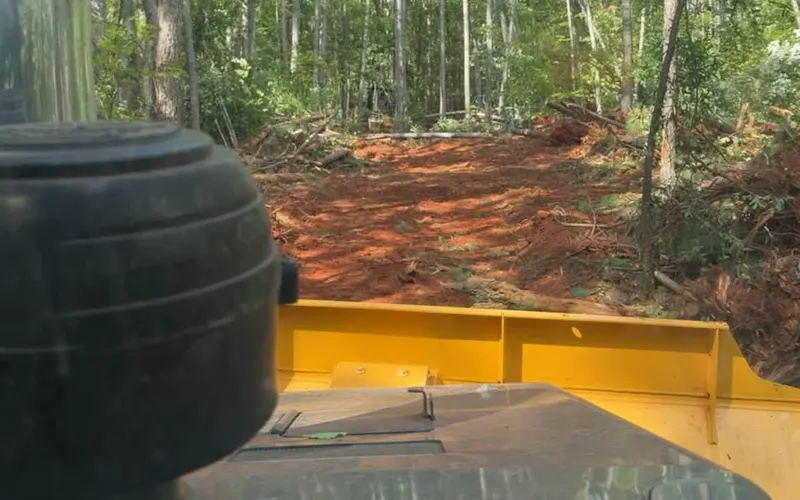
Often, no. Cutting trees on your own land in North Carolina usually doesn’t need a permit by itself. What brings in the rules is how much ground you disturb, where the land sits, and what comes after the trees: the stumps, the brush, a new driveway, a house.
So the better question is which of those lines your job crosses. Most of them are easy to check before a machine shows up, and a few calls now are much cheaper than a stop on the work later.
When Does Clearing Land Need an Erosion Control Plan?
The state rule that matters most is about mud, not trees. North Carolina’s Department of Environmental Quality says that if more than one acre of land on a tract is to be disturbed, an erosion and sedimentation control plan is required. DEQ says the plan must be submitted at least 30 days before the work starts and approved before any land-disturbing activity begins. State law adds that no building permit is issued for work covered by the erosion law until that plan is approved, and DEQ lists fines of up to $5,000 per day per violation for starting without one.
It is the ground you disturb that counts, not the size of your property. Add up every place the ground will be stripped, dug or piled: the house pad, the driveway, the yard, the topsoil stockpile and the spot where the stumps get pushed. If the total comes anywhere close to an acre, ask before you start.
Rutherford County is served by DEQ’s Asheville Regional Office in Swannanoa. The county, Rutherfordton, Forest City and Spindale aren’t on DEQ’s 2024 list of local erosion programs, and DEQ says that without a local program you contact the regional office for your area, so start with Asheville and ask them to confirm who handles your site.
Under an acre there is no plan to file, but the rules don’t switch off. DEQ says erosion and sedimentation control is required regardless of the size of the disturbance, and state law says graded slopes left exposed must be planted or otherwise covered within 21 calendar days of finishing any phase of grading. On a foothills slope, bare red clay runs into the ditch, the creek and the neighbor’s yard with the first hard rain, so plan for silt fence, mulch and seed on a job of any size.
Inside Town Limits or Out in the County
Where the land sits changes who you ask. Rutherford County, Rutherfordton and Forest City each run their own inspections office, so the first thing to find out is whether your land is inside a town’s limits.
- Forest City. The town’s building page says that “most interior and exterior work requires a building permit,” which matters as soon as the clearing is for a house or a shop.
- Rutherfordton. The town lists a floodplain development permit and a zoning permit among its forms. If your land in town runs down to a creek or a low bottom, ask about the floodplain permit before anything there is cleared, filled or graded.
- Outside the towns. Ask the county inspections office what applies to your parcel.
- Spindale, Ruth, Lake Lure and the other towns. Start with town hall and ask who issues permits there.
Offices don’t all treat clearing the same way, so ask the one that covers your land about clearing, grading and fill, not only about the house that comes later.
Do You Need a Permit to Burn the Brush?
Often, and burning comes with two sets of rules of its own. The NC Forest Service requires a burning permit between midnight and 4 p.m. for a fire in or within 500 feet of woodland it protects, and the state’s air quality rule for land clearing fires adds conditions on distance, hours, wind and what goes on the pile. We go through both in burning brush after land clearing in NC. If you are hiring the clearing done, ask how the debris will be handled before you sign, because that answer changes both the rules and the price.
Call 811 Before Any Stump Comes Out
Pulling a stump is digging, and so is cutting a ditch or the first pass of a driveway. NC 811 says to contact 811 three working days before you dig, and state law sets the window at three to 12 full working days before the start date, so call once the date is set, not the morning the machines arrive. If you hire the work done, ask who is placing the call. The utilities then mark their publicly managed lines for free, and NC 811 asks you to stay at least 24 inches outside the marks or dig by hand.
The marks don’t cover everything. NC 811 says calling will not get your private lines marked: electric lines to outbuildings, propane lines from the tank, and the water and sewer lines between the meter and the house are the owner’s to find. On a clearing job that means the well line, the power to a barn or an old line to a field, so walk the land with whoever is clearing it and flag them.
A New Driveway Onto a State Road
Clearing land for a new home usually means a new entrance too. NCDOT’s driveway permit FAQ says anyone who plans to develop property or alter an existing access must get a driveway permit to obtain or modify access to the State Highway System. It also says NCDOT charges no fee to apply, and that small or simple requests are typically processed in four weeks or less after you submit them.
The permit is for state-maintained roads, not town streets or private roads. If your drive will meet a state road, ask the NCDOT District Engineer’s office for Rutherford County (Division 13) before the entrance is cut. Where the drive meets the road is also where water from the road ditch wants to go, so plan the grade and the pipe there early.
Questions to Answer Before You Clear
Work through these before anyone starts cutting. Each answer tells you which call to make.
- How much ground will be disturbed in all, counting the drive, the house site and the stockpiles?
- Is the land inside a town’s limits, and which inspections office covers it?
- Does any of it run down to a creek, a pond or a low bottom that could be floodplain?
- Where will the logs, brush and stumps go: hauled off, chipped, piled or burned?
- Will the driveway meet a state road?
- Has 811 been called in time, and do you know where your own buried lines run?
- Which trees are staying, and are they marked with ribbon?
Bring the Answers When You Call
Have these answers ready when you call about land clearing, along with what the land is for. They shape the job and the quote more than the trees do. If you are still pricing the work, our post on what it costs to clear an acre covers what moves a quote, and clearing land for a house walks through the order of the job from the first ribbon to the rough grade.
Common Questions About Land Clearing Permits
-
The Asheville Regional Office of NC DEQ answers at 828-296-4500, and DEQ's erosion hotline is 1-866-STOPMUD (1-866-786-7683).
-
No. DEQ ties the plan to the land the work disturbs, so a big farm with a small cabin clearing is a different case from a tract where the house, the drive and a pasture are all opened up.
-
State law exempts farming on agricultural land and timber harvests done to the Forest Practice Guidelines, and the timber exemption is lost if the guidelines aren't followed. Clearing a lot for a house is neither, so the usual rules apply.
-
Ask the Asheville office before you plan around it. Bare ground left open between stages washes too, so seed and mulch each part as you finish it.
Published H&L Landscaping and Grading