Call: (828) 289-8180
  Fully insured. Grading, land clearing and 24/7 tree service in Rutherfordton & surrounding areas.

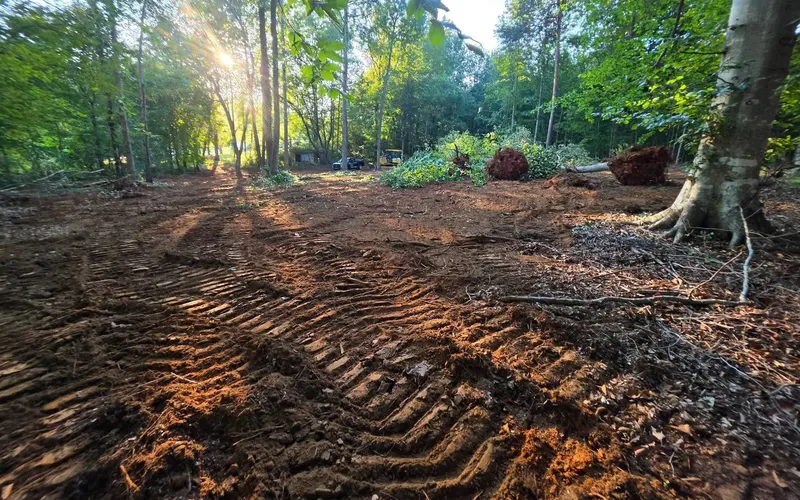
There is no honest single price for clearing an acre of land in North Carolina, because no two acres are the same job. An acre of pasture gone to briars clears quickly. An acre of mature oaks and poplars on a hillside, with a creek at the bottom and stumps that all have to come out, is a much bigger job.
What we can tell you is what moves the cost up or down. If you know these things about your land before you call, the quotes you get will be easier to compare, and you will know what each one leaves out.
What Moves the Price of Clearing an Acre
These are the questions a contractor weighs while walking your property. Each one changes the time, the machines and the trucking the job needs.
- What is growing there. Brush, briars and small saplings clear fast. Big hardwoods take longer to cut, move and get rid of, and a thick stand of pines leaves a lot of tops and limbs behind.
- The slope and the ground. A flat field is the easy case. Steep ground, rock, wet spots and soft red clay after a rain slow the machines down and sometimes call for different equipment.
- The stumps. Cutting trees down is one job. Pulling the stumps and roots out where a house, a driveway or a pasture will go is another, and it leaves holes that need filling.
- What happens to the debris. Logs, limbs, brush and stumps have to go somewhere: hauled off, chipped, left in piles at the edge or burned where the rules allow it. Each choice costs something different.
- Access. A lot with a road to it is quicker to work than one where we have to cut our way in first. On one of our jobs we had to build a road to reach a retaining wall site, then put the land back the way it was.
- How finished you want it. Cleared and rough, or cleared, graded smooth and seeded, are very different end points.
- Erosion control. Silt fence and seeding to keep mud on your land and out of the creek and the road add to the job, and on bigger sites the state requires a plan.
Why One Acre in Rutherford County Can Cost More Than Another
Around Rutherfordton, Spindale and Forest City the same acre can look easy from the road and turn out to be a hillside with a wet hollow in the back. The foothills put many lots on a slope, and once the topsoil comes off, the red clay underneath turns slick and sticky after rain.
That is why we would rather walk the land than price it from a listing or a satellite photo. Where the trees are, where the water runs and where the house or the pasture will sit decide most of the work. Clearing a house site in the woods while keeping the best trees is slower than flattening everything, and it is worth it when the trees are why you bought the land.
Do You Need a Permit to Clear Land?
Cutting trees on your own land usually doesn’t need a permit by itself, but the ground you disturb can. North Carolina’s Department of Environmental Quality says an erosion and sedimentation control plan must be submitted at least 30 days before work begins on any site disturbing more than one acre, and approved before the work starts.
Inside town limits there may be other rules as well, so check with your town or the county. We go through the permits in more detail in do you need a permit to clear land in NC.
What Happens to the Brush and Stumps?
Ask this before you sign anything, because it is where quotes differ most. Some prices include hauling everything away, some leave the brush piled at the tree line, and some assume it will be burned.
Burning has its own rules. North Carolina’s air quality rule for land clearing fires, for example, keeps the burn at least 500 feet from any home or occupied building that is not on your property, and only plant growth from the clearing may go on the fire. Our post on burning brush after land clearing covers the permits and the rest of the rule.
If the stumps come out, the holes get filled and packed, or the ground settles later right where you didn’t want it to.
How to Get Quotes You Can Compare
Before anyone comes out, a little homework makes the quotes line up.
- Walk your property lines, or find the survey, so everyone clears the same ground.
- Tie ribbon around the trees you want to keep.
- Decide what the land is for: a house, a pasture, a garden, a view. That decides how clean it has to be.
- Ask each contractor the same things: are stumps included, where does the debris go, is grading and seeding part of the price, and who handles the erosion control.
- Call NC 811 at least three working days before any digging, stump pulling included, so buried utility lines get marked.
“H&L did several roads for my construction company, and cleared land and provided grading for us.”
Tally, Google review
When Clearing Is Only the First Step
Clearing is often the start, not the whole project. On one job in September 2026 we did the land clearing, a retaining wall and the grading, with hydroseeding to follow. Doing it in one go means the bare clay isn’t left open to the rain for weeks.
If you are clearing for a home, read how to clear land for a house for the order of the work, and see what goes into preparing a house site. To have us look at your acre, see our land clearing page or call (828) 289-8180, and tell us what the land is for.
Common Questions About Land Clearing Costs
-
Yes. You mark the trees and areas to keep, and the crew works around them. It changes how the work is done, so mention it when you ask for a price.
-
It can. The International Society of Arboriculture names construction, grade changes and soil compaction as causes of root loss and decay, so keep machines and fill away from the roots of the trees you want to save.
-
It depends on the same things as the price: what is growing there, the slope, the stumps and where the debris goes. We can give you a fair idea once we have walked the land.
-
Not the whole time. It helps to walk the property with the crew before work starts and point out the lines, the trees to keep and anything buried, like an old well or a septic tank.
Published H&L Landscaping and Grading